Paddle Materials: Every Face and Core, Compared
A paddle's playing character starts with two decisions: what the face is made of, and what sits behind it. This hub compares the face and core materials we source, scores them on feel, spin, durability and cost, and maps which combinations serve which players.
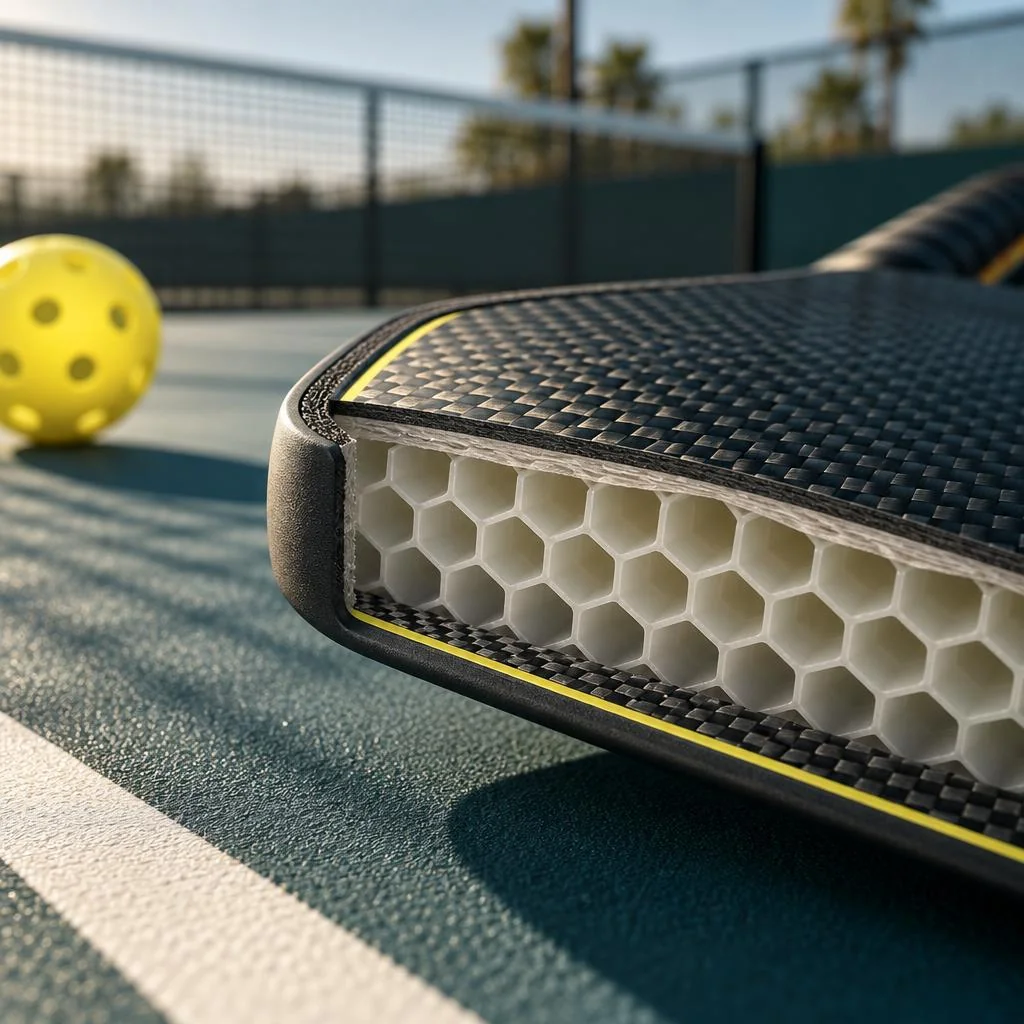
Two decisions define a paddle
Every construction we build answers the same two questions — what hits the ball, and what sits behind it. Pick one option from each column and you have a buildable spec. The guides below take each material apart in full.
Face Materials
- Raw carbon fiber (T700-grade prepreg) — coarse as-cured surface, control-and-spin feel
- Woven carbon — cross-weave cloth, firm all-court feel
- Fiberglass — flexible, forgiving, cost-efficient
- Composite blends — mixed plies tuned between carbon and glass
Core Materials
- PP honeycomb, standard thickness — the mainstream core
- PP honeycomb, thick-core 14.1–16mm — the current trend
- Nomex honeycomb — hard, loud, power-forward
- Polymer foam — plush and muted; sourced for specialty builds on request
Four faces, scored on what buyers ask about
Read this matrix as a buying tool, not a ranking — each face trades one strength for another. The row links open the full guide for that material.
| Face Material | Feel | Spin Potential | Durability | Cost Tier | Best For |
|---|---|---|---|---|---|
| Raw carbon (T700-grade) | Firm, direct, control-leaning | High — coarse as-cured surface grips the ball cover | Strong surface wear resistance; edge guard carries impacts | Premium | Intermediate to advanced players; spin-first lines |
| Woven carbon | Firm with a touch more compliance | Moderate to high, from weave and finish texture | Similar to raw carbon | Premium | All-court players; design-forward models |
| Fiberglass | Soft, lively, forgiving | Moderate — grip comes from finish and swing | Good; flex absorbs impact stress | Value to mid | Beginners and recreational retail lines |
| Composite blend | Between carbon and fiberglass | Tunable through the carbon-to-glass ratio | Balanced across wear modes | Mid | Private-label lines that need one SKU to cover many players |
Recommended combinations by play style
Face and core are chosen together — the pairing, not either spec alone, defines the build. These are the combinations we specify most often.
| Play Profile | Face | Core | Why It Works |
|---|---|---|---|
| Control and touch | Raw carbon | Thick PP (14.1–16mm) | A firm face over an absorbing core stretches dwell time for dinks and resets |
| Spin-first baseline | Raw carbon | Standard PP | Coarse surface texture plus a crisper launch keeps pace on the swing, where spin lives |
| Power and put-aways | Raw or woven carbon | Nomex honeycomb | Stiff face on a hard core returns energy fast, with the loud report power players want |
| Forgiving all-court | Woven carbon or composite | Standard PP | Softer engagement with balanced response covers mixed shot selection |
| Beginner and recreational retail | Fiberglass | Standard to thick PP | A flexible face widens the effective sweet spot and holds price down |
| One-SKU private label | Composite | Standard PP | A tuned blend lands between power and control for mixed customer bases |
What the core adds to the equation
The face decides surface character; the core decides launch, dwell and comfort — how long the ball stays on the paddle and how the contact sounds and feels.
| Core | Character | Feel Contribution | Common Builds | Cost Tier |
|---|---|---|---|---|
| PP honeycomb | Thermoformed polypropylene cells | Absorbing, medium feel that softens as thickness grows | Standard thickness; thick-core 14.1–16mm | Value to mid |
| Nomex honeycomb | Resin-dipped aramid-paper cells | Hard, crisp, loud; minimal vibration damping | Performance and power builds | Mid to premium |
| Polymer foam | Closed-cell foam fill | Plush, muted, dense | Specialty and thermoformed unibody builds | Mid to premium |
We source foam-core constructions on request — note it in your spec brief. The two honeycomb guides cover the mainstream options.
Five materials, five deep dives
Carbon Fiber Face
Raw T700-grade prepreg versus woven carbon — and how each lands on feel, spin and price.
Read the guideFiberglass Face
The flexible, forgiving face behind beginner lines and volume retail programs.
Read the guideComposite Face
Mixed-ply faces that split the difference — the private-label workhorse.
Read the guidePP Honeycomb Core
The mainstream core: thickness, density and the 14.1–16mm thick-core trend.
Read the guideSame terms whatever the material
Material choice changes the build, not the commercial frame. These are our standing terms, quoted against your spec — not introductory exceptions.
Questions buyers ask before choosing materials
Which face material should a first private-label line start with?
Composite or fiberglass if the line needs to serve a broad customer base on one budget; raw carbon if the brand positions on performance and spin and prices for it. We sample the shortlist before you commit an MOQ.
Does a thicker core always play softer?
Thicker cores generally add dwell time and soften feel, but the face, the weight band and the player's swing complete the picture. Treat thickness as a starting point and validate it in sampling, not on a spec sheet.
Is raw carbon worth the premium over fiberglass?
For control-and-spin players, usually yes. For beginner and value lines, rarely — the premium buys surface character and stiffness, and neither matters much to a player still building consistent contact.
Can I mix materials across the SKUs in one order?
Yes. MOQ applies per SKU, so one range can pair a carbon-face control model with a fiberglass beginner model inside the same production window. We confirm the construction of each SKU in the material declaration that ships with the batch.