Composite Faces: Blending Carbon and Glass on Purpose
A composite face mixes carbon and fiberglass plies in one layup, then tunes the ratio until the paddle sits where the brand wants it — firmer than fiberglass, friendlier than pure carbon. That tunability is why private-label lines default here.
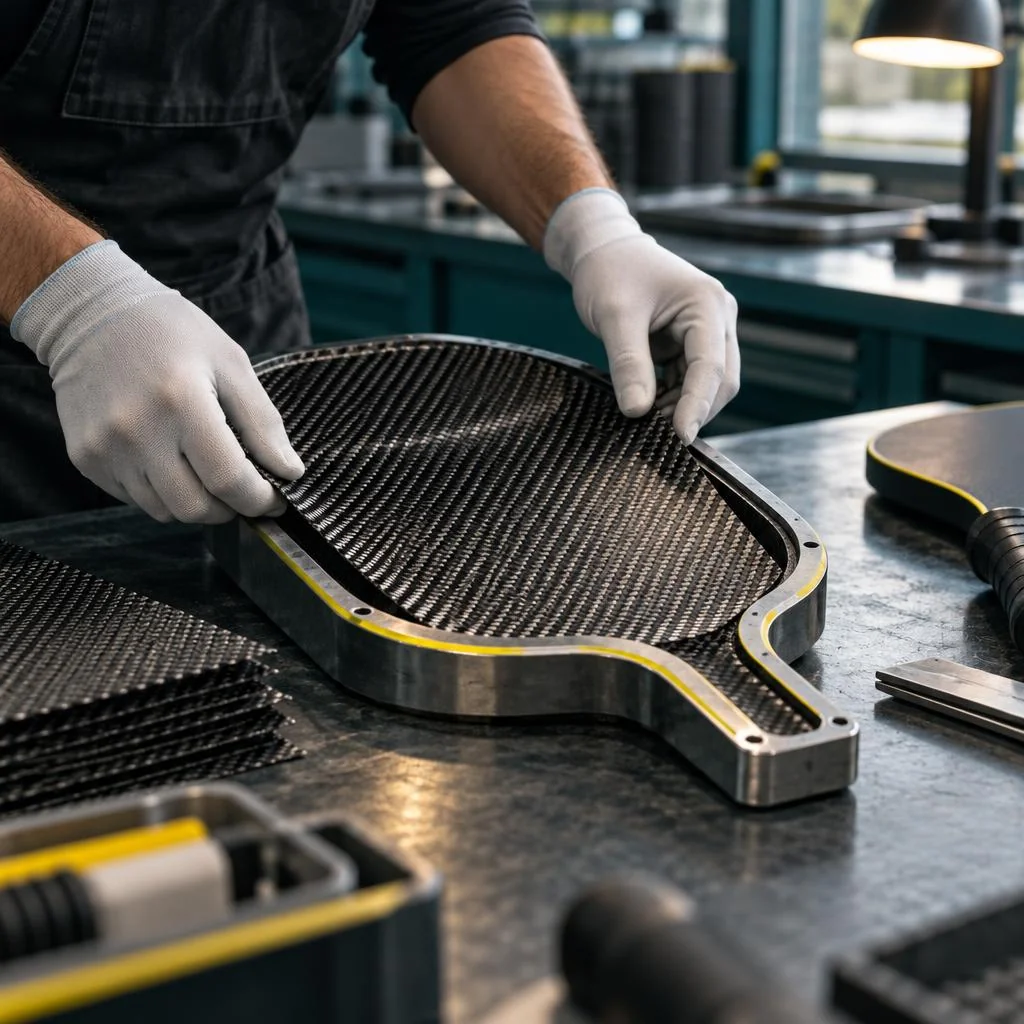
The composite face, dimension by dimension
Composite does not win any single dimension — it avoids losing any of them. That balance is the product.
| Dimension | What a Composite Face Brings |
|---|---|
| Structure | Mixed-ply layup — carbon and glass, sometimes with foam layers, combined in one face schedule |
| Feel | Between the two pure faces — firmer than fiberglass, more forgiving than raw carbon |
| Spin | Tunable — more carbon in the mix raises surface grip; sampling sets where the SKU lands |
| Durability | Balanced — the blend spreads wear modes instead of excelling at one |
| Cost | Mid tier — carbon share pushes the number up, glass share holds it down |
How a blend becomes a product
What gets specified
Two variables define a composite face: the carbon-to-glass ratio, and where each ply sits. A full-face mix spreads both materials evenly across the hitting surface. A carbon hitting zone with glass toward the perimeter puts stiffness where the ball lands most and forgiveness where misses happen. Both are legitimate strategies, and sampling exists to move the ratio until the target feel shows up in hand — each construction is then written into the layup schedule and the material declaration that ships with the batch.
Ratio changes re-enter sampling rather than jumping straight to production. That is the discipline that keeps a composite SKU reproducible batch after batch — the blend is a spec, not a mood.
Why private-label lines default here
A first product line rarely knows exactly who its customer is yet. A composite face lets one SKU serve the improving intermediate, the all-court rec player and the lapsed tennis convert at once, because its response sits inside everyone's comfort zone. Price follows: the blend lands mid-tier, so the retail story reads "genuine carbon content" without the premium-tier price tag.
The same logic scales as the line grows. Brands typically open with a composite anchor model, then add a raw-carbon control SKU above it and a fiberglass value SKU below — a three-tier range where every tier has a defensible construction story.
Composite vs. hybrid: naming, clarified
The market uses both words loosely. As we build them: a composite face is a mixed-material layup — carbon and glass in one construction. "Hybrid" is the broader retail term for any paddle that blends traits from two design directions, which can mean materials, shape, or both. Most paddles marketed as hybrids have a composite face at their core. When you brief us, describe the playing outcome you want; we translate it into plies, not vocabulary.
Who a composite face serves
On court: the player profile
Improving intermediates and all-court players who dink and drive in the same game. Also the answer for players who tried pure carbon, found it too stiff, tried fiberglass, found it too lively — the blend keeps what they liked from each.
In the catalog: the buyer profile
Private-label launches, the mid tier of a retail range, and clubs or programs that need one durable SKU for mixed-ability use. If the brief says "broad appeal, credible performance, controlled cost," composite is the default answer.
Specifying composite with FULVERA
The ratio is the spec, and sampling is where the ratio is set — plan for one tuning round before the MOQ.
Cost structure and the questions that keep quotes comparable: what drives custom paddle cost. Commercial frame: Sourcing & Factory
Related guides
What Is a Hybrid Pickleball Paddle?
Hybrid paddles blend shape or material traits from two design directions to avoid over-committing to pure power or pure control.
What Does It Cost to Manufacture a Custom Pickleball Paddle?
A breakdown of what actually drives cost up or down, and the questions to ask a factory before assuming a quote is comparable to another.
How to Choose the Right Pickleball Paddle: Weight, Shape & Core
Skip the marketing adjectives and compare the actual construction variables side by side: face, core, shape and weight.
Questions buyers ask about composite faces
Is composite the same thing as hybrid?
The words overlap in the market. In our usage, composite describes the face construction — mixed carbon and glass plies — while hybrid is the broader retail label for any paddle blending two design directions. Most hybrid-marketed paddles ride on a composite face. What matters in a brief is the playing outcome, not the label.
Is a composite face a downgrade from carbon?
No — it is a different product decision. A tuned blend trades a slice of carbon's precision for forgiveness and a mid-tier price. For many target players, and for most first lines, that trade lands closer to what the customer actually wants than a pure carbon spec would.
Can the carbon-to-glass ratio be customized?
Yes — that is the point of the construction. Ratio and ply placement are written into the layup schedule, and any change re-enters sampling so the feel is re-confirmed before production. The approved construction then ships documented in the material declaration.
What MOQ applies to composite builds?
The same standing frame as every construction: from 200–500 units per SKU, lower for private-label trial runs and negotiable by construction type. Samples run 7–12 business days from a confirmed spec sheet, and bulk production 25–35 days.