Polypropylene Honeycomb: The Core Most Paddles Ride On
PP honeycomb became the default core for a simple set of reasons: it bonds reliably in the mold, absorbs vibration, keeps weight predictable and costs less than the alternatives. Thickness and density are the two dials that tune everything else.
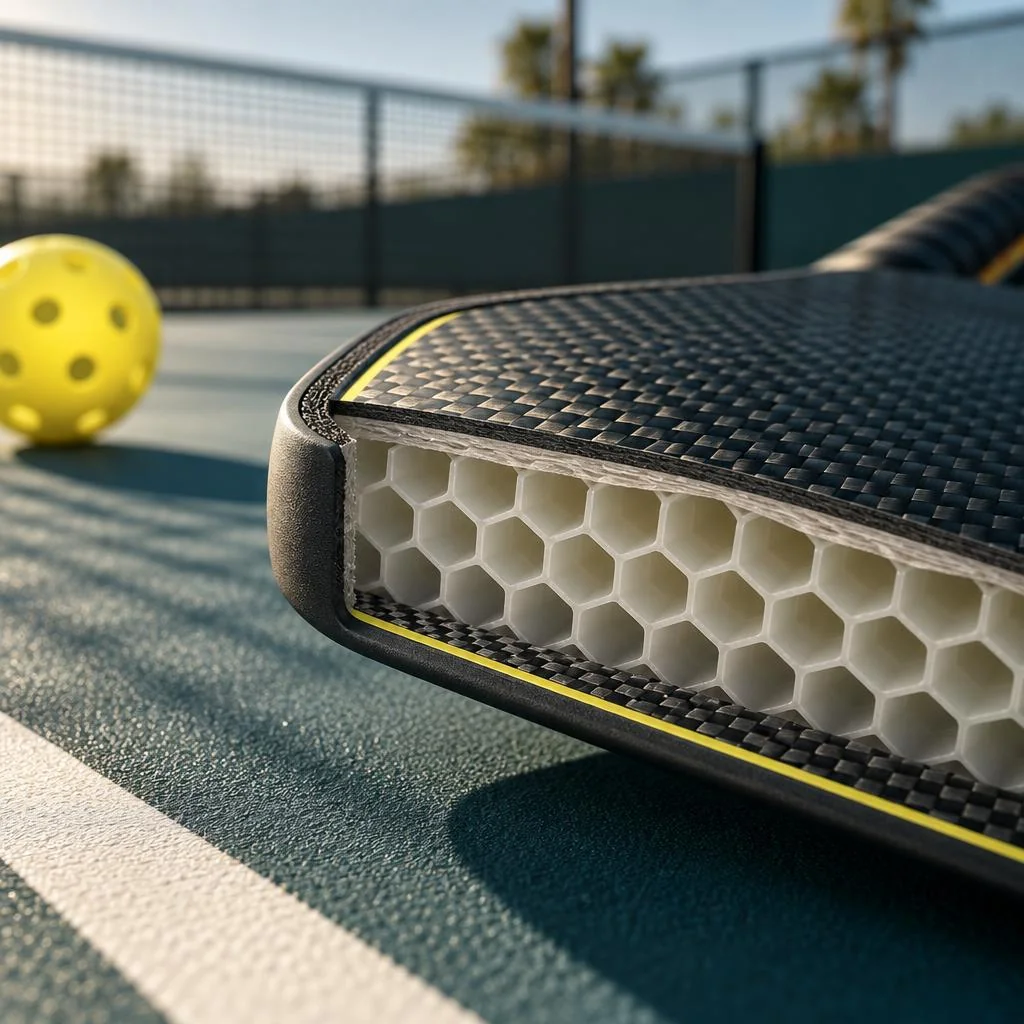
The PP core, dimension by dimension
A neutral core in the best sense: it takes on the character the face gives it, and adds comfort and consistency of its own.
| Dimension | What a PP Honeycomb Core Brings |
|---|---|
| Structure | Thermoformed polypropylene honeycomb sheet bonded between the face skins in a matched mold |
| Feel | Absorbing and medium-bodied — softens as thickness grows, the most joint-friendly response among mainstream cores |
| Spin | Neutral — the core shapes dwell and launch, not surface grip; spin still comes from the face |
| Durability | Proven at volume — core wear concentrates at the edges first, so edge sealing and guard choice decide longevity |
| Cost | The value benchmark among cores, at any thickness |
Thickness and density: the two dials
Why PP became the default
Volume manufacturing favors materials that behave the same every time, and PP honeycomb does: its cell structure forms and bonds consistently under the heat-press cure curve, it lands inside the target weight band without fighting the layup, and it tolerates every face material in the library — carbon, glass or composite. Incoming inspection samples core density per lot before stock enters the warehouse, which is the kind of check a consistent material passes quietly, batch after batch.
The playing result is equally cooperative. PP absorbs vibration instead of passing it to the hand, which suits long sessions and a wide range of players. When a brand needs a harder, louder response instead, that is a job for Nomex honeycomb.
What thickness changes
Thickness sets the trade between dwell and launch. A thicker core flexes and recovers more, holding the ball on the face a fraction longer and absorbing more of the impact; a thinner core returns the ball faster with a crisper, more direct feel. Neither is better — they are different products.
| Core Build | Playing Tendency | Where Lines Use It |
|---|---|---|
| Standard thickness | Crisper launch, more direct feedback, quicker handling | All-court and precision builds |
| Thick core, 14.1–16mm | Longer dwell, softer absorbing feel, more forgiving off-center | Touch-friendly and beginner-plus builds — the current thick-core trend |
What density changes
Density tunes the same thickness in two directions. Higher-density cells firm up the response and add weight; lower-density cells soften the feel and save it. Brands usually lock thickness first for the playing profile, then adjust density in sampling to land the weight band and the firmness the target player expects. Both values are written into the material declaration, so the spec survives from sample to batch.
The 14.1–16mm thick-core trend
The market has shifted toward thicker cores, because the dwell-and-absorb character fits how most people actually want a paddle to feel. The trade-offs are physical: a thicker body needs weight management to stay in band, and it leans harder on edge construction for protection. That is why thick-core builds pair naturally with careful edge sealing, standard edge guards, or thermoformed unibody construction when the design goes edgeless. We build both standard and 14.1–16mm thick cores as standing options — the choice is a spec decision, not an upgrade path.
Who a PP core serves
On court: the player profile
Nearly everyone — that is the point. Control players on standard thickness, touch players on thick, and anyone who plays long sessions benefits from the vibration absorption. It is the core we recommend by default and the one players rarely need to move away from.
In the catalog: the buyer profile
The default core for most SKUs: retail lines, private-label ranges and institutional volume orders. It is the safest first core for a new line — proven at volume, certified without surprises, and costed to leave margin. Reserve specialty cores for targeted models at the top of the range.
Specifying PP core with FULVERA
Thickness and density are the two values to put in your spec sheet — everything else follows the standard frame.
Core density is sampled at incoming inspection and the approved values travel in the material declaration with every batch. How materials move through the line: Factory Tour
Related guides
Pickleball Paddle Core Thickness Explained
A thicker or thinner core changes far more than weight — it reshapes dwell time, feel and the entire power-versus-control balance of a paddle.
What Type of Pickleball Paddle Is Best?
Shape, face material and core construction each pull performance in a different direction — here is how the main paddle types compare.
What Makes a Pickleball Paddle Good? Materials & Construction
A technical look at the face, core, edge, and grip choices that actually determine how a paddle performs.
Questions buyers ask about PP cores
Is a 16mm core always more controllable?
Thicker cores tend toward control — more dwell, more absorption — but the face, the weight band and the player's swing complete the picture. A stiff face over a thick core still launches firmly. Treat thickness as the starting point of the spec and confirm the feel in sampling.
Does a thicker core sacrifice power?
It trades some free pace for dwell and forgiveness. The player generates that pace back with swing speed, which is why thick-core builds suit players who swing through the ball rather than blocking it. For blocked-pace styles, a standard thickness usually fits better.
PP or Nomex — which core should I choose?
PP for broad-appeal lines, comfort and cost control. Nomex for hard, loud, power-forward models aimed at advanced players. Most ranges carry PP across the line and add Nomex as the power model at the top — see the Nomex core guide for the full comparison.
Do PP cores break down over time?
Core wear concentrates where paddles take their beating: the edge. Cell crush starts there, which is why edge sealing and edge-guard fit are checked on the line. A properly sealed and guarded PP core holds its playing character through a normal product life; the batch documents record the core spec it was built to.