
Core thickness is one of the more technical specs on a paddle listing, and also one of the most consequential. It's easy to skim past a number like "14mm" without understanding what it changes about how the paddle actually plays. This article explains what the core does, why thickness matters, how it interacts with other construction choices, and how to think about it whether you're buying one paddle or specifying a production run.
What the core actually does
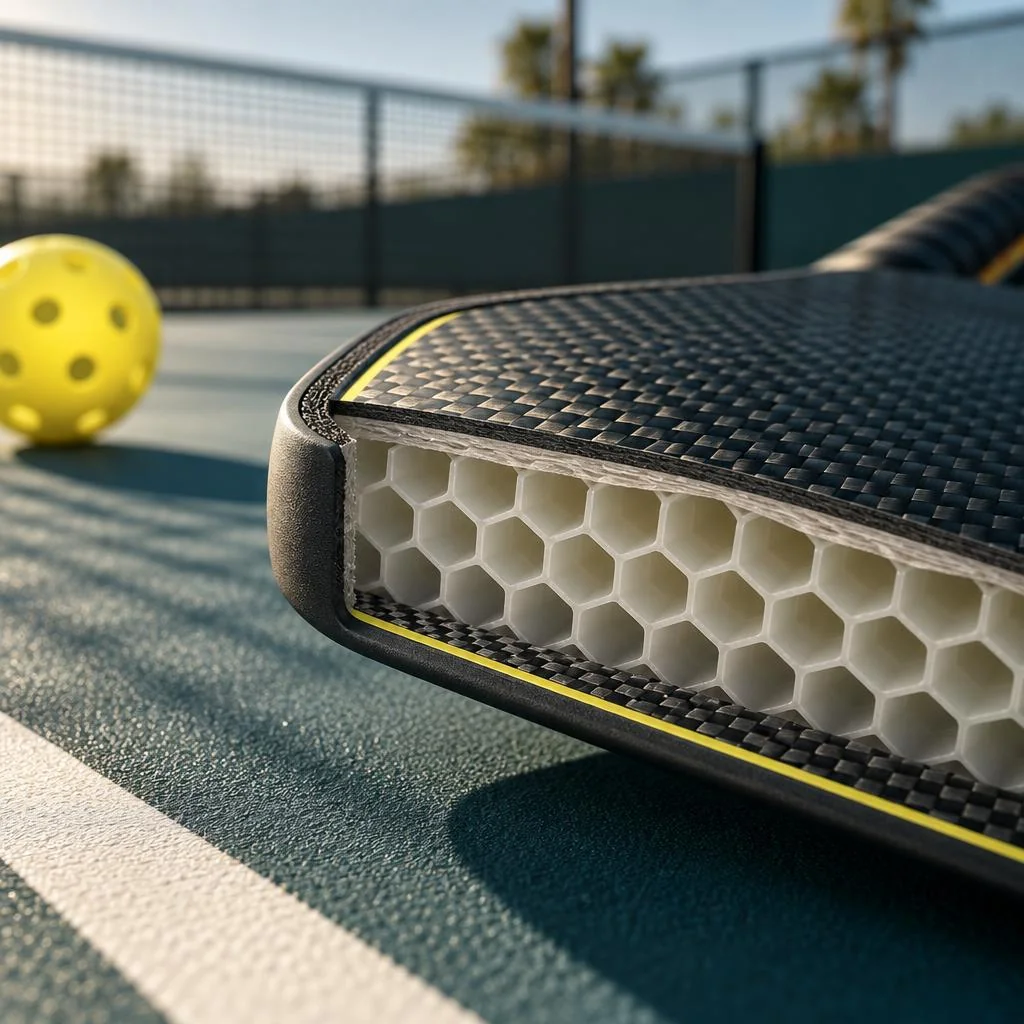
The core sits between the two paddle faces and does most of the work in absorbing and redirecting the energy of ball contact. Most modern cores use a polypropylene honeycomb structure — a lightweight lattice of hexagonal cells — chosen for its strength-to-weight ratio and its ability to be tuned through cell size and wall thickness. Some paddles use Nomex honeycomb, a stiffer aramid-based structure that was more common in the sport's earlier years, or polymer foam cores in certain construction types. Regardless of material, the core's job is the same: shape how the ball's energy is absorbed and returned during the brief window of contact.
Dwell time: the concept that explains everything else
Dwell time refers to how long the ball actually stays in contact with the paddle face before leaving it — typically measured in fractions of a millisecond, but perceptible to players as a difference in feel. A thicker core generally compresses more under impact, extending dwell time and giving the player a longer window to influence the shot's direction and spin, which is why thicker cores are generally associated with control and touch. A thinner core generally compresses less, shortening dwell time and producing a quicker, more energetic rebound — generally associated with power.
Typical thickness ranges and what they favor
| Core category | General characteristic | Typically favors |
|---|---|---|
| Thinner core | Shorter dwell time, crisper rebound | Power, faster exchanges |
| Mid-range core | Balanced dwell time | All-court versatility |
| Thick core (up to ~14.1–16mm) | Longer dwell time, softer contact | Control, touch, dinking |
These categories are general tendencies rather than fixed rules — the same core thickness can play differently depending on the face material it's paired with and the density of the honeycomb cells used.
How core thickness interacts with face material
Core thickness rarely determines feel on its own — it works together with face material. A thick core paired with a carbon fiber face produces a paddle that's soft on touch shots but still precise, since the stiff face keeps ball direction predictable even as the thick core absorbs energy. A thin core paired with a fiberglass face produces a livelier, more power-oriented paddle where both the face and the core contribute to a fast rebound. Manufacturers typically design these combinations deliberately to hit a specific position in the power-to-control spectrum, rather than varying one spec at a time. Our sourcing and factory page covers the full range of core and face combinations available in production.
Does core thickness affect weight?
Somewhat, but less than most players expect — honeycomb cores are engineered to be lightweight regardless of thickness, so the difference between a thin and thick core's contribution to overall paddle weight is generally modest compared to the weight added by the face laminate, edge guard and handle materials. Weight and core thickness are related but separate decisions, and a thick-core paddle isn't automatically heavier than a thin-core one.
Choosing core thickness for your game — or your product line
As a player, core thickness is worth choosing deliberately based on where you sit on the power-versus-control spectrum: newer or control-oriented players generally do well starting thicker, while players chasing pace and already comfortable with technique may prefer thinner. As a brand or retailer specifying a paddle for production, core thickness is one of the first construction variables to lock in, since it interacts with certification testing (deflection and PBCoR both respond to core characteristics) as much as it does with player feel. Confirming core spec through a physical sample — rather than a spreadsheet number alone — remains the most reliable way to validate the final feel before a bulk order.
Core Thickness Myths Worth Unlearning
A few persistent myths distort how buyers think about core thickness. The first is that thicker cores automatically mean less power. While the general tendency holds at the extremes, the difference between adjacent thicknesses, say 14mm versus 16mm, is subtle enough that face material and swing speed often dominate the outcome. Choosing purely by the thickness number risks missing the paddle that actually performs.
The second myth is that thin cores are only for power hitters. Control players with compact, quick swings sometimes prefer thinner cores for the immediate, connected response at the kitchen line. The third myth treats thickness as a skill ranking, as if advanced players must migrate toward thin cores. In reality, plenty of professionals choose thicker constructions for their consistency under pressure.
The practical takeaway is to treat core thickness as one input among several, best settled by playing rather than by reading spec tables, and to be suspicious of any guidance that assigns a single thickness to a whole skill level.