Core Technology: The Lattice That Decides How a Paddle Feels
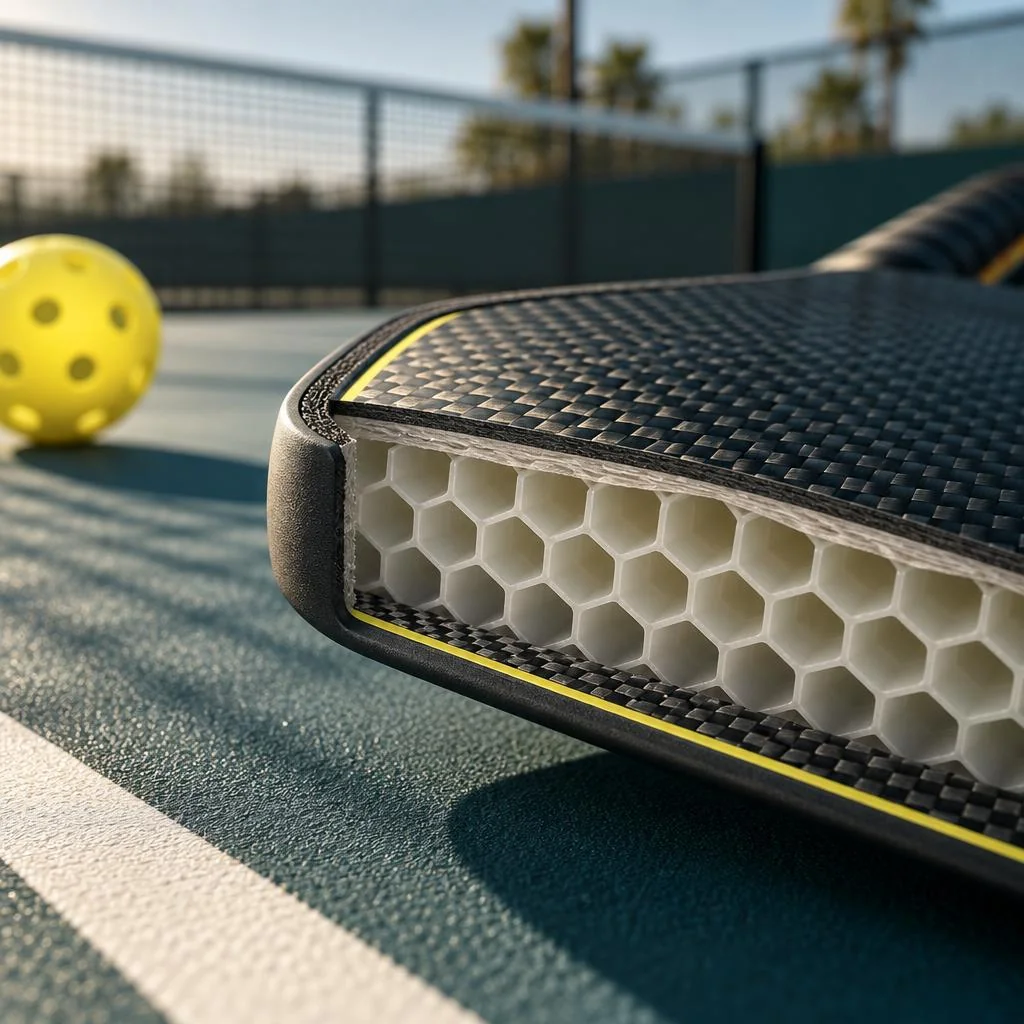
Between the two faces sits a honeycomb lattice doing most of the work on every hit — absorbing the ball's energy, then handing it back. Getting that sandwich right is a two-stage craft: prepare and stack the core to the layup schedule, then bond it to the faces so the bond outlives the warranty.
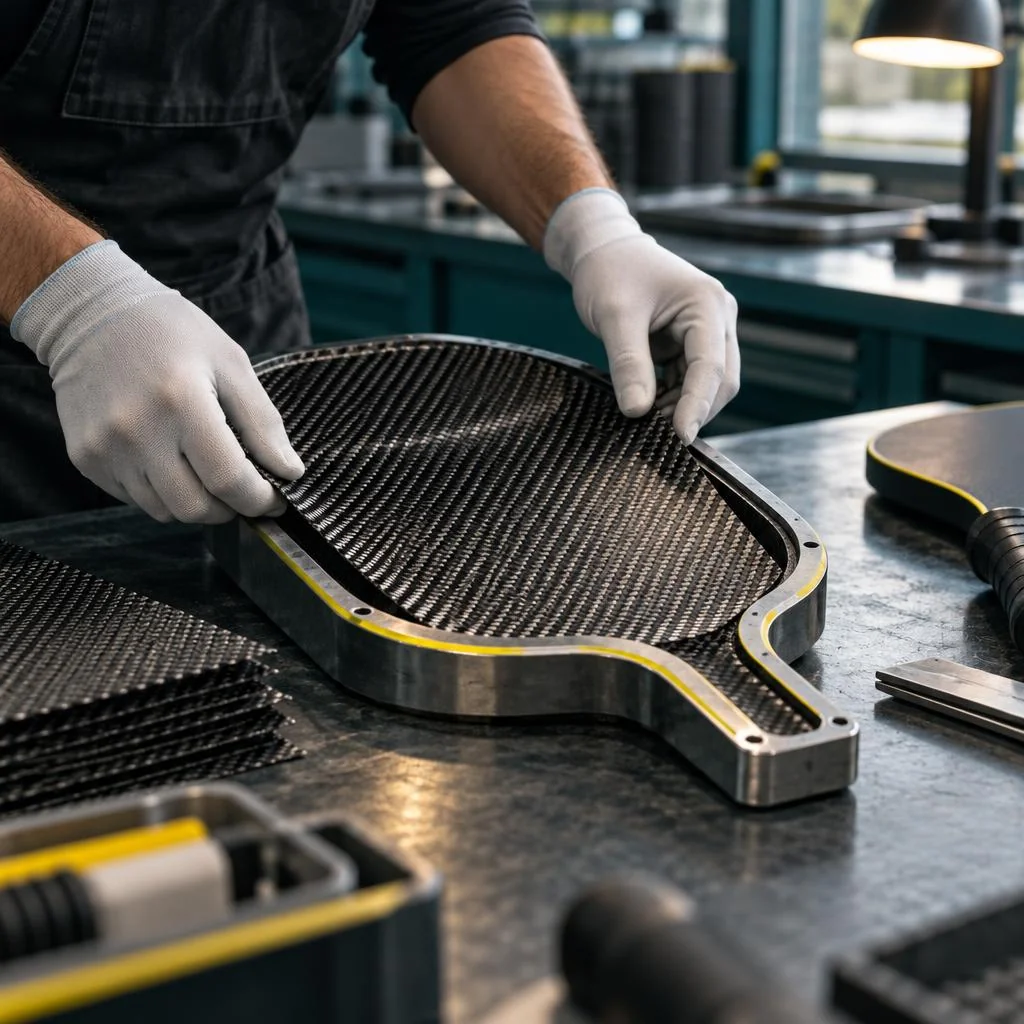
Phase 01 — Materials & Core Assembly, line stages 01–02
Materials & Core Assembly
Layup schedule, core prep and face-core bonding.
Heat-Press Molding
The cure curve that sets bonding and batch consistency.
Open phase 03Surface & Finishing
Texture, coating and compliance at the face.
Open phase 04Inspection & Dispatch
Final checks, batch documents and the full line.
Open phaseWhat the core stage controls
A paddle core is a lightweight lattice of cells — most commonly polypropylene honeycomb, with Nomex honeycomb and polymer foam appearing in specific constructions. The lattice's job never changes: shape how the ball's energy is absorbed and returned. The craft is in four variables that decide how well it does that job, paddle after paddle.
Core material & density
Cell structure and density set the baseline response — softer and more forgiving through stiffer and louder. Incoming core sheets are density-sampled against the approved material declaration before they enter stock.
Core thickness
Thickness reshapes dwell time — how long the ball sits on the face. Thicker builds favor control and touch; thinner builds answer faster and livelier. It is the first spec to lock with face material, never alone.
The layup schedule
Ply count, fiber orientation and stacking order are written down per SKU and verified against a template before every mold closes. The schedule — not the operator's habit — is the spec.
The face-core bond
Adhesive film and mold consolidation create the skin-to-core interface. That bond carries every impact; its quality is set here and finished in the press cure.
The three core defects buyers actually meet
Core problems are the ones players describe in reviews — a rattle, a dead spot, a paddle that weighs wrong. Each traces to a controllable stage failure.
Core shift
If the core is not located and held correctly in the mold, it can migrate before the resin sets. The result shows at the perimeter: an uneven margin, and an edge guard that fits one side tight and the other gapped.
Voids and unbonded pockets
Trapped air or starved bond lines leave face areas sitting loose over the core. Players tap a paddle and hear the difference: dull spots where the face is not carrying. In play they become dead zones, then cracks.
Density and thickness drift
Core stock that sneaks in off-spec — wrong density lot, wrong thickness — shifts weight and feel across a batch without any single panel failing a visual check. The defense is at incoming inspection, not downstream.
The stations behind these controls — incoming inspection bay, cutting area, layup station — are listed with their equipment and control points on the Factory Tour equipment table.
Three product decisions the core stage makes for you
Feel, tuned on purpose. Core thickness and density are your main levers on the power-control spectrum, and they interact with the face material you pair them with. A factory that treats these as spec'd, sample-verified variables — not "close enough" stock — gives you a line where the control model and the power model actually play differently.
Durability, priced at the bond. Most premature paddle failures start at the skin-to-core interface, not the face. A verified layup and a properly cured bond are why some paddles survive a season of edge balls and others delaminate in month two — a difference your warranty reserve will feel before your customers tell you.
Weight, held in a band. Because the core is most of a paddle's volume, its consistency drives your weight-band hit rate. Tight incoming density checks and schedule-verified layups are what let a 200-unit order ship as one weight class instead of two.
How core quality is verified before shipment
The core stage feeds three checkpoints of the five-checkpoint QC pipeline.
Incoming material
Core sheets and resin verified against the approved material declaration, with density sampling on every lot. Non-conforming lots are quarantined, not reworked.
Layup verification
Ply count, orientation and stacking order checked against the layup schedule before each mold closes.
Post-mold checks
Weight band and dimensional checks catch shifted cores and bond problems at the panel stage, and deflection screening flags weak laminates per batch.
The pipeline from intake to lab, step by step: Quality & Certification. Every station and its equipment, in one table: Factory Tour. The overview map: Craftsmanship.
The terms around this stage
Two guides that pair with this page
Core questions from buyers
Which core material should I spec for my line?
Start from your target player, not from a material ranking. Polymer honeycomb suits most modern builds for its balance of softness and weight; Nomex appears where a firmer, louder response is wanted, and foam cores in specific constructions. We confirm the choice on a physical sample against your target feel, since core and face interact.
What exactly is "core shift" and why does it happen?
It is the core moving out of position inside the mold before the resin sets — usually from handling, loading, or cure pressure that overwhelms the locating design. You see it as an uneven perimeter and edge-guard fit problems. It is prevented at layup and molding, which is why our layup is verified against the schedule before every mold closes.
Is a thicker core automatically better?
No. Thicker cores extend dwell time and favor control and forgiveness; thinner cores answer faster and favor power. "Better" depends on the player you are building for — and the same thickness plays differently depending on the face it is paired with.
How do you catch unbonded areas before shipping?
Layered checks: weight-band screening at the panel stage, where voids scatter weights; per-batch deflection sampling, where weak laminates flag as outliers; and final visual and sound inspection before packing. A batch that fails returns to the stage that owns the defect.