Surface Finishing: Spin Character, Held Inside the Rules
The face finish is the most regulated square foot of a paddle. Sanding, coating and texture application decide how much spin your line generates — and surface-roughness standards decide how much texture is legal. Craft at this stage means hitting your target feel and the compliance line at the same time, batch after batch.
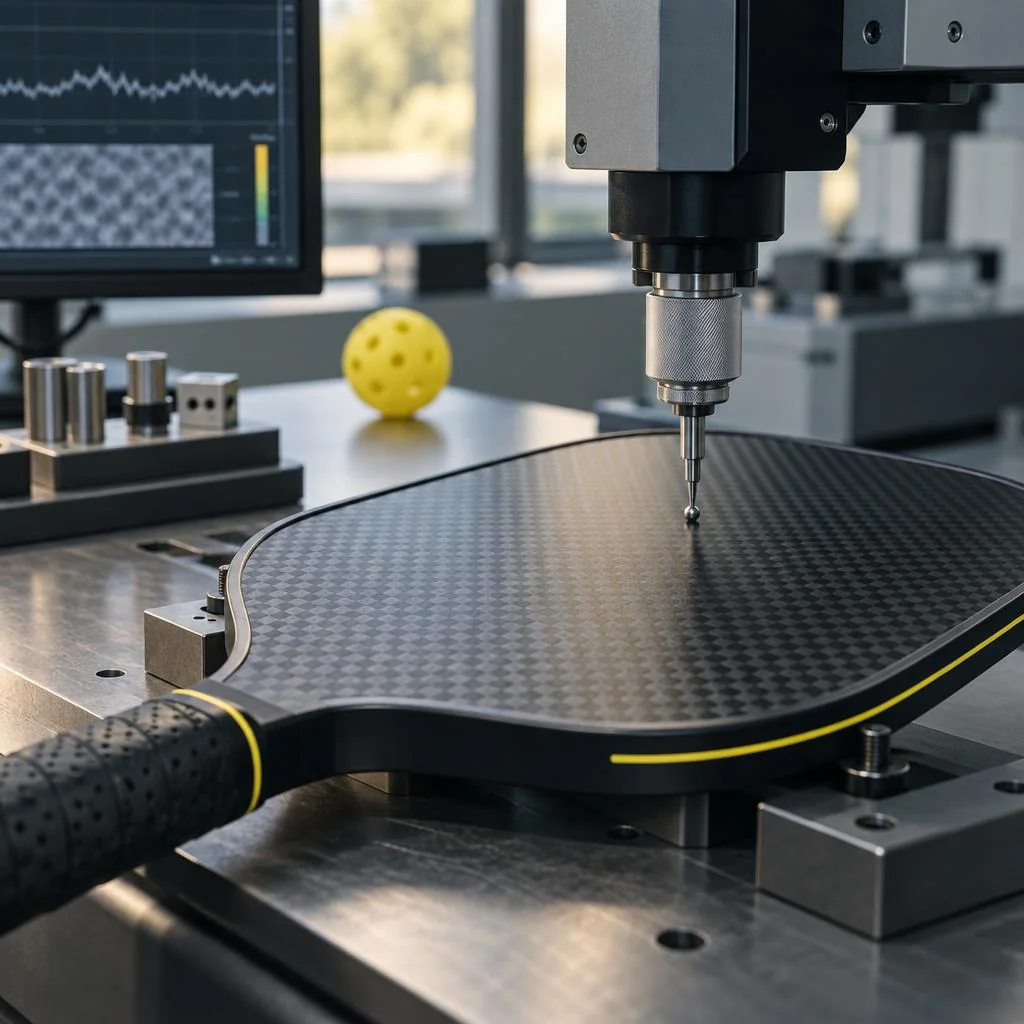
Phase 03 — Surface & Finishing, line stages 04–07
Materials & Core Assembly
Layup schedule, core prep and face-core bonding.
Open phase 02Heat-Press Molding
The cure curve that sets bonding and batch consistency.
Open phaseSurface & Finishing
Texture, coating and compliance at the face.
Inspection & Dispatch
Final checks, batch documents and the full line.
Open phaseWhat finishing does to the face
A molded panel comes out of the press with a usable face but not a finished one. Four steps take it to spec — and each one owns a variable that shows up in play.
Sanding & prep
Faces are sanded to clean, level the cured surface and open it for coating. Prep quality decides how evenly everything after it lands — the reason a bad finish usually starts before the finish.
Texture & coating
Grip-building texture comes from applied coatings or from textured skins and the native weave of the carbon itself, then a protective coat seals it. The route shapes both feel and how the finish wears.
Cure
Coatings cure in ovens to a stable, measurable state. An under-cured finish reads one way on the roughness instrument and another after two weeks in a player's bag.
Roughness sampling
Faces are sampled against the certified-sample baseline on an optical profilometer. Over-textured panels are rejected here — at the station, not at final inspection or worse, in a market-sample re-test.
Spin sells. De-listing doesn't.
USA Pickleball's approval testing includes a surface-roughness check with an optical profilometer, built to catch spin-generating surfaces — and once a paddle is approved, production units have to keep matching the tested sample. The standard has teeth: in late 2024, follow-up testing found production units of a major brand exceeding the roughness limit, triggering a temporary de-listing and a replacement program.
That is the specific failure this stage exists to prevent. The rule we run is simple: the finish that leaves the line must be the finish the lab tested. Texture is sampled against the certified-sample baseline at the station, and a batch that drifts rough never reaches the packing bench.
The test-by-test breakdown, including the current deflection and roughness landscape: Quality & Certification.

Three finishing defects and where they land
Finishing problems divide into the kind that stop a shipment and the kind that quietly reach customers. The first kind is cheap here. The other two are not.
Over-texture
A face rougher than the certified baseline fails compliance — and if it slips through, the exposure lands on your brand as a de-listing or market-sample failure, not on the factory. This is the defect the station-level roughness check exists to catch.
Uneven texture and gloss drift
Inconsistent prep, coat or cure shows as visible variation across the faces in a carton. The paddles play fine and look second-run — the kind of quality signal customers read straight into your brand.
Poor coating wear
An under-cured or under-spec'd coat wears unevenly in play — slick patches where texture used to be. It passes every check at shipment and surfaces months later as "the spin faded" reviews.
Three things a held finish does for your line
Finishing is where your product's on-court identity gets applied — and where its paperwork risk gets retired.
A spin identity you can market
Texture, paired with face material, sets where your paddles sit on the spin spectrum. Holding the finish to spec means the spin story on your box matches the paddle in the customer's hand.
Certification that survives audits
Approval is granted to a sample; the market tests the batch. Station-level roughness screening keeps shipped units inside the tested envelope, so your approval status stays an asset instead of a liability.
Shelf-level visual consistency
Uniform gloss and texture across a batch is what makes forty paddles on a retail wall look like one product. Cosmetic consistency is a finishing discipline before it is a branding one.
Decoration and grip — the later stages of this phase — run on the same line: registration and ink adhesion spot-checked per batch, grips built to the ordered circumference. Their stations sit in the Factory Tour equipment table.
How finish quality is verified before shipment
Finishing feeds the pre-test screening and batch consistency checkpoints of the QC pipeline.
Baseline at the station
Surface roughness sampled on an optical profilometer against the certified-sample baseline. Over-textured faces are rejected here.
Decoration checks
Graphics registration and ink adhesion spot-checked per batch, with dimensions re-verified after decoration.
Pre-shipment sampling
Roughness and deflection re-screened on final samples, so the batch document set records the finish against the tested baseline.
The full five-checkpoint pipeline: Quality & Certification. Every stage in sequence: Factory Tour. The overview map: Craftsmanship.
The terms around this stage
Two guides on spin and its limits
Finishing questions from buyers
How much spin texture can a legal face actually carry?
More than enough to matter, less than marketing implies. Approval testing caps surface roughness on an optical profilometer, and the cap applies to production units, not just the submitted sample. The workable approach is to target a texture profile inside the limit and hold it — the paddles that get de-listed are the ones that drifted past it after approval.
Can I request a specific texture for my product line?
Yes — texture route, coating and target roughness are specified per SKU and confirmed on a physical sample against the baseline. What we will not do is target a finish outside the compliance envelope; the sample you approve is the finish the batch is held to.
How do you keep texture consistent across a 500-unit batch?
Consistency comes from the baseline, not from operators' eyes: faces are sampled on the profilometer against the certified-sample reference at the finishing station, and cosmetic checks cover gloss and uniformity per batch. Drift is corrected at the station or the batch is pulled there.
What happens if a batch is found over-textured?
It stops at finishing. Over-textured faces are rejected at the station and reworked or scrapped before decoration, because pulling them later costs a finished batch — and shipping them costs your certification status. The roughness record travels with the batch document set.