Heat-Press Molding: One Cure Curve, Every Paddle in the Batch
Molding is where a paddle's materials become a paddle. The press closes on the layup and runs a programmed temperature-and-pressure curve that cures the resin and bonds skin to core. Hold that curve, and every panel in the batch comes out the same. Let it drift, and no amount of downstream inspection puts the feel back.

Phase 02 — Heat-Press Molding, line stage 03
Materials & Core Assembly
Layup schedule, core prep and face-core bonding.
Open phaseHeat-Press Molding
The cure curve that sets bonding and batch consistency.
Surface & Finishing
Texture, coating and compliance at the face.
Open phase 04Inspection & Dispatch
Final checks, batch documents and the full line.
Open phaseWhat the press actually does
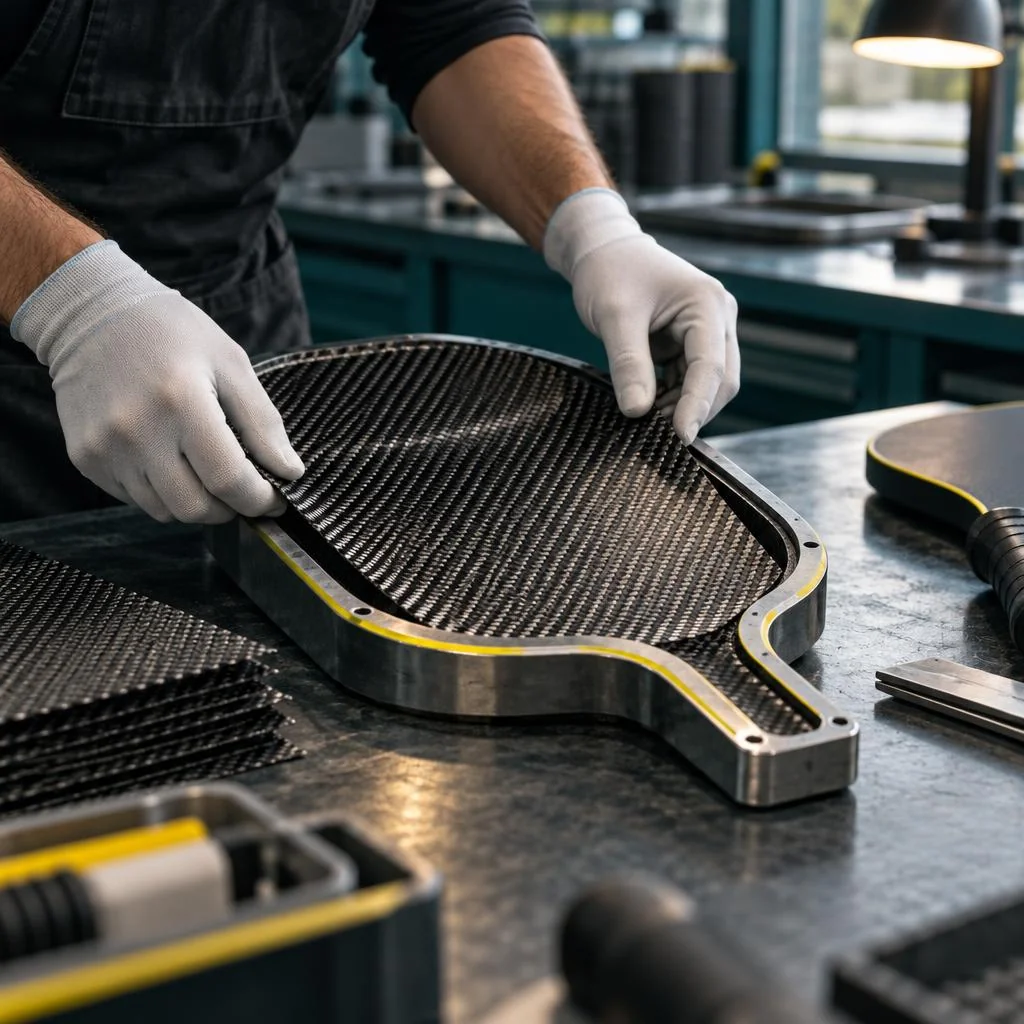
A cured paddle is a sandwich: face skins, core, face skins, consolidated into one laminate. The heat press is the only station that can create it. Three things happen inside the closed mold, and they all hang off one control point.
The resin cures
Prepreg resin cross-links from a tacky state into a rigid matrix as temperature ramps, dwells and cools. The shape of that curve — not just the peak — decides how completely the resin sets.
The layers bond
Pressure consolidates the stack and presses resin into the core surface, creating the skin-to-core bond that carries every impact the paddle will ever take.
The laminate stabilizes
Controlled cool-down under pressure locks the panel flat and true. Rush this leg and the panel leaves the mold with locked-in stress that shows up later as warp.
The control point is the programmed temperature-pressure curve — ramp, dwell and cool-down — run identically on every cycle, with molded panels weighed against the target weight band as an immediate readout. The equipment behind it, platen presses with programmable cure profiles, is listed on the Factory Tour equipment table.
What a bad cure curve does to a batch
Molding defects rarely announce themselves at the press. They surface weeks later — in a customer review, a warranty claim, or a certification re-test. Three failure patterns account for most of them.
Delamination and weak bonds
An under-cured or under-pressurized cycle leaves resin that never fully cross-linked. Layers that look bonded separate under edge-guard crimping or a hard edge ball — the classic mid-life paddle failure.
Voids and soft spots
Trapped air and uneven pressure leave unbonded pockets. Players feel them as dead zones in the face; a batch with voids also scatters on weight, because the voids never weigh the same twice.
Warp and weight drift
Inconsistent cooling or cycles run off-curve release panels with internal stress. Faces come out twisted, and post-mold weights spread beyond the target band — the first symptom a buyer notices when "every paddle plays different."
Your consistency problem is usually a molding problem
When a brand says its paddles "feel different from unit to unit," the cause is rarely the materials list — two panels cut from the same prepreg roll are nearly identical. The cause is that the two panels took different paths through the cure. A line that records and repeats its curve hands you something valuable: a product your customers can trust to feel like the last one they bought.
Molding also sets your tuning space. Deflection and PBCoR — the two lab tests that gate approval — both respond to how fully the laminate cured and how stiff the bonded sandwich became. A factory that holds its cure window can move a construction toward power or control deliberately, instead of discovering where it landed after the lab does.
And it sets your yield. Panels weighed outside the band, or flagged at deflection screening, are pulled at this stage — priced as scrap panels rather than as finished goods, returns and reputational damage.
How molding quality is verified before shipment
Molding sits inside the five-checkpoint QC pipeline. Three of its controls live at or immediately after the press.
Curve on record
Each cycle runs the approved programmed profile. The curve — not a machine brand — is the audit item.
Post-mold weight band
Every molded panel is weighed against the target band. Outliers are pulled here, before value is added.
Deflection screening
Per-batch samples go through in-house deflection checks, catching under-cured laminates before the lab ever sees them.
How the tests work and what they gate: Quality & Certification. Every station and its control point, in one table: Factory Tour. The overview map: Craftsmanship.
The terms around this stage
Two angles on why molding matters
Molding questions from buyers
Why does molding matter more than the materials list?
Materials set the ceiling; molding decides whether a paddle reaches it. The same prepreg and core produce a consistent paddle under a held cure curve and an inconsistent one under a drifting press — which is why two "identical" spec sheets can play completely differently.
Can you change how a paddle plays without changing materials?
Within limits, yes. Construction choices made at molding — layup schedule, cure window, resulting laminate stiffness — shift a paddle along the power-control spectrum. The bigger, deliberate moves come from combining these with core thickness and face material, validated on a physical sample.
What does a failed cure show up as later?
Typically as complaints rather than at intake: paddles that feel dead in spots, rattle or creak as layers separate, weights that scatter across a carton, or faces that twist over time. All three trace back to molding and are cheapest to catch at the post-mold weight check.
How do you prove my batch was molded to the same standard as the sample?
The batch document set records the checks tied to molding: dimension and weight inspection results, deflection spot-check sampling, and a batch traceability reference tied to your purchase order. Production units are re-screened against the certified sample, not just against the spec sheet.