
"What are good pickleball paddles" is a slightly different question from "what's the best paddle for me." Fit is personal — weight, grip size and shape depend on your game. But whether a paddle is objectively well made is not personal at all. It comes down to material selection, manufacturing consistency and quality control, and those traits are checkable regardless of your skill level or play style. This guide separates the two, focusing on what actually makes a paddle "good" from a construction standpoint.
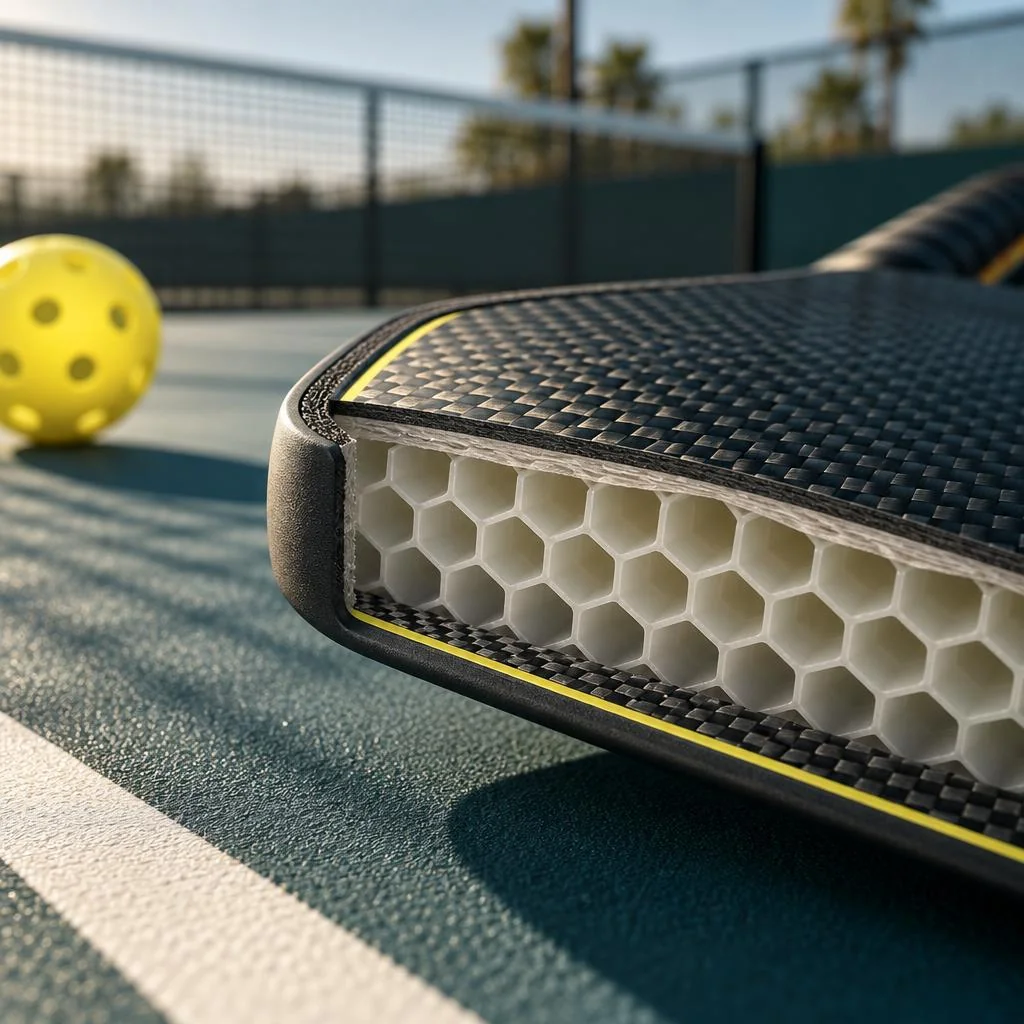
Good starts with the face material
The paddle face is the primary contact surface, and its material drives both feel and durability. The three material families used across the industry are:
- Carbon fiber — generally the firmest, most control-oriented feel, and typically the most durable against surface wear over repeated play.
- Fiberglass — usually softer and livelier, often associated with more pop on contact, at some cost to long-term surface durability compared to carbon fiber.
- Composite blends — combine fiberglass and other fibers to sit between carbon and pure fiberglass in feel and cost.
None of these is universally "better" — they are different tools. A good paddle uses its stated material correctly and consistently, rather than mixing in lower-grade substitutes to cut cost while marketing the higher-grade term. This is one of the areas where factory-level material sourcing discipline matters more than the brand printed on the paddle; our sourcing page details how face and core materials are specified and verified before production.
Good means a stable, well-molded core
Beneath the face sits the core — usually polypropylene honeycomb, sometimes Nomex honeycomb, in standard or thicker profiles in roughly the 14.1–16mm range. A well-molded core keeps its honeycomb cell structure intact through the heat-press process; a poorly controlled one can develop uneven density, leading to dead spots or inconsistent bounce across the face. This is one of the hardest defects to catch by eye, which is why consistent process control at the molding stage matters more than it might seem from the outside.
Good means the unit you get matches the spec sheet
A paddle model can be well-designed on paper and still ship inconsistently if a factory's quality control is weak. Good paddle manufacturing means:
| Spec | What consistency looks like |
|---|---|
| Weight | Falls within the advertised range for every unit in a batch, not just the sample sent to reviewers |
| Grip circumference | Matches the stated size (small, medium, large) across units of the same model |
| Balance point | Consistent head-heavy, head-light or neutral balance across units |
| Edge finishing | No sharp seams, uneven edge guard adhesion, or visible resin pooling |
This is where quality control checkpoints — incoming material inspection, in-process dimension sampling, and a post-production batch consistency audit — do the real work of keeping "good" from becoming "good on the good days."
Good means independently verified, not just claimed
Any brand can describe its paddle as tournament-ready. Independent certification is what actually verifies it. USA Pickleball and UPA-A testing checks deflection (face rigidity), PBCoR (how much a flexing face can amplify ball speed), and surface roughness (which governs spin potential), alongside dimensional limits of 17 inches in length and 24 inches combined length plus width including edge guards. Standard testing generally takes 4 to 6 weeks, with expedited turnaround available in 3 to 8 business days. Our quality and certification page covers what each test actually measures and why post-certification batch drift is a real risk worth screening for.
Good is not the same as expensive
Price and quality are correlated but not identical. Higher prices often reflect brand marketing spend, retail markup and premium material grades, but a mid-priced paddle from a factory with strong process control can outperform a higher-priced paddle from one with weak QC. The traits above — material consistency, core stability, spec accuracy and certification — are a more reliable filter than price alone.
A quick self-check before buying
- Is the face material clearly and specifically named, not just described as "premium"?
- Is the exact model listed on a current USA Pickleball or UPA-A approved list?
- Do independent reviews of the same model report consistent weight and feel?
- Is there a clear return or warranty path if the paddle warps or delaminates?
If a paddle checks these boxes, it qualifies as objectively good — whether or not it turns out to be your personal favorite is a separate, and much more subjective, question.
Warning signs of a poorly made paddle
The traits above describe what good construction looks like; it is just as useful to know what a weak one looks like in practice. Watch for a face that develops visible dead spots — areas where the ball noticeably loses pace on contact compared to the rest of the face — which usually points to uneven core density from inconsistent molding. Watch for a paddle that measures noticeably outside its advertised weight when checked on a scale, which suggests loose production tolerances. Watch for edge guard seams that lift or separate within the first few sessions, a common sign of rushed assembly. None of these defects are always visible before purchase, which is exactly why material disclosure, consistent independent reviews and a clear warranty matter as much as they do — they are the best available proxies for construction quality before you have the paddle in hand.