
A pickleball paddle looks simple — a flat face, a handle, roughly the size of a large frying pan — but eight distinct specifications combine to determine how it performs and holds up. Missing any one of them tends to cause a specific, predictable problem later: hand fatigue from the wrong grip, a dead feel from a mismatched core, or disqualification from sanctioned play over a certification gap. This checklist walks through all eight in a logical order.
1. Weight
Weight sits on a spectrum from lightweight to heavyweight. Lighter paddles favor quick hands and lower cumulative arm strain; heavier paddles add power with less swing effort but react more slowly at the net. There is no universally correct weight — it is a trade-off to make deliberately based on your play style and any joint or muscle sensitivity.
2. Grip circumference
Grip size is the specification most likely to cause discomfort if wrong, and the easiest to get right by measuring your hand or testing options in person. A grip too large forces extra effort to control the paddle; a grip too small increases twisting on off-center contact. Most paddles come in small, medium and large grip circumferences.
3. Core thickness and material
Cores are typically polypropylene honeycomb, with variants including Nomex honeycomb and thicker profiles in roughly the 14.1–16mm range. Thinner cores generally feel livelier and more responsive; thicker cores generally dampen vibration and widen the forgiving zone on the face. Neither is inherently better — the choice depends on whether you prioritize touch or stability.
4. Face material
Carbon fiber, fiberglass and composite blends are the three main face material families. Carbon fiber tends toward a firmer, more control-oriented feel with strong surface durability; fiberglass tends toward a softer feel with more pop; composite blends sit between the two. Material choice affects both feel and how long the face resists surface wear.
5. Surface texture
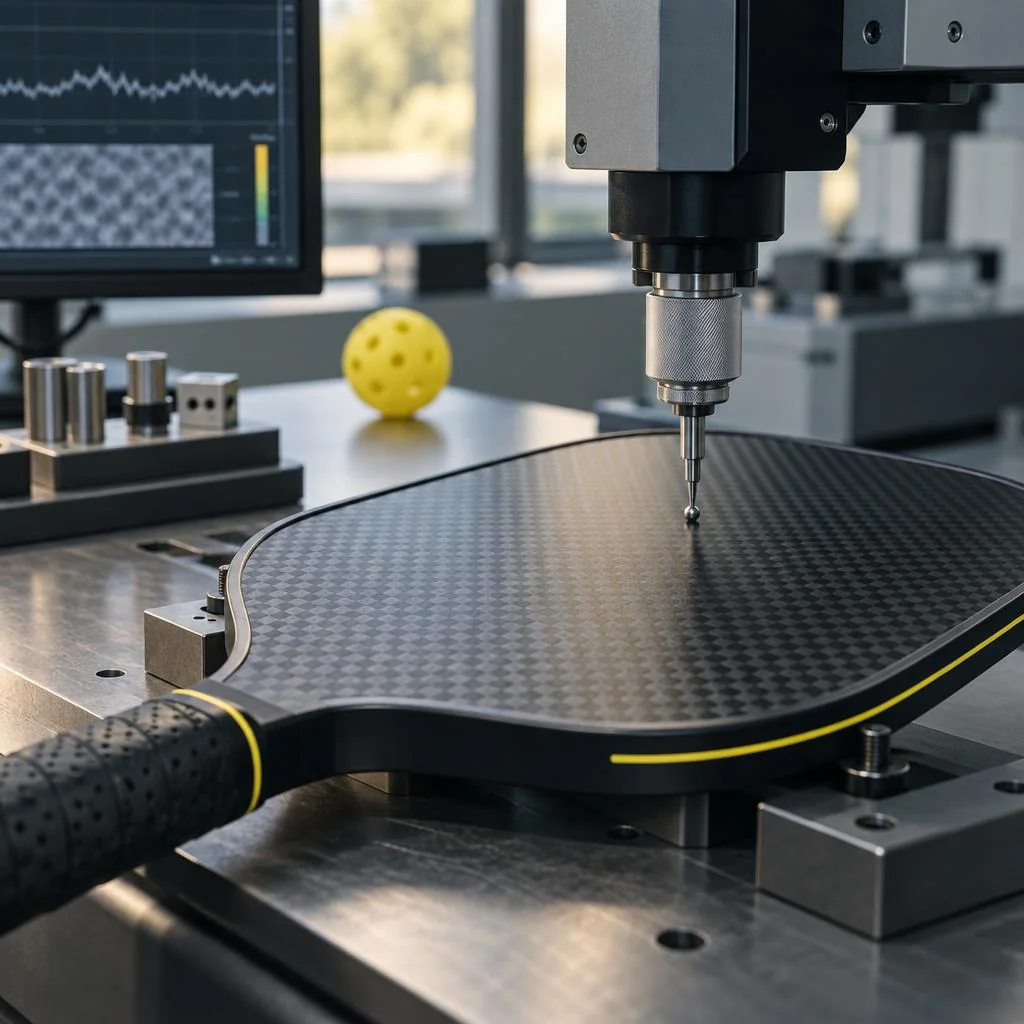
The microscopic texture of the face affects how much spin a player can generate, which is exactly why USA Pickleball and UPA-A test surface roughness with an optical profilometer as part of certification. A rougher, more textured surface generally allows more spin, within the limits the certification testing enforces.
6. Shape
Standard, elongated and wide-body shapes redistribute the sweet spot and reach differently. Elongated shapes add reach and swing leverage at the cost of a narrower sweet spot; wide-body shapes widen the sweet spot at the cost of some reach. All shapes must still fit within USA Pickleball's 17-inch length limit and 24-inch combined length-plus-width limit, including edge guards.
7. Certification status
If sanctioned play matters to you, confirm the exact model — not just the brand — is currently listed as USA Pickleball or UPA-A approved. Certification testing covers deflection, PBCoR and surface roughness, and standard testing typically takes 4 to 6 weeks, with expedited options in 3 to 8 business days. Our quality and certification page details what each test measures and why post-certification consistency matters just as much as the initial approval.
8. Warranty and return terms
Even a well-designed paddle can arrive with a manufacturing defect, or develop delamination or warping over time. A clear warranty or return policy indicates a brand's confidence in its own construction and gives you recourse if a specific unit falls short of the model's typical quality.
Putting the checklist to work
| Check | Why it matters |
|---|---|
| Weight | Determines power-versus-maneuverability trade-off and arm strain risk |
| Grip circumference | Prevents hand fatigue and control loss |
| Core thickness | Sets touch versus stability feel |
| Face material | Affects feel and surface durability |
| Surface texture | Governs spin potential within certified limits |
| Shape | Redistributes sweet spot and reach |
| Certification | Confirms eligibility for sanctioned play |
| Warranty | Provides recourse for defects |
Run any paddle you are considering — whether a single retail purchase or a bulk order for a facility — through all eight points rather than anchoring on one flashy spec. For buyers building a paddle line from scratch, this same checklist doubles as a construction brief; our sourcing overview covers how each of these specs gets translated into a factory-ready production spec.
How priorities shift between recreational and competitive buyers
Not every point on this checklist carries equal weight for every buyer. A recreational player picking up the sport for the first time can reasonably treat certification and warranty terms as secondary to grip size, weight and core thickness — the factors that determine day-one comfort and enjoyment. A competitive player preparing for sanctioned league or tournament play should flip that order, confirming certification status before finalizing any other preference, since an otherwise perfect paddle is disqualified from sanctioned use if the specific model is not on the current approved list. Facilities and retailers sit in between: they typically need to satisfy both groups at once, which is why many end up stocking a certified, mid-weight, moderately forgiving paddle as a safe default for shared or rental use, while offering more specialized options for players who know exactly what they want.
Whichever end of that spectrum you fall into, revisit the eight points periodically rather than treating a single purchase as final. Grip preference, weight tolerance and material feel can all shift as your game develops, and a paddle that checked every box a year ago may be worth re-evaluating once your technique or your league's competitive level changes.