
Shoppers usually ask "how much does a pickleball paddle cost" while looking at a retail price tag, but the more useful question is what that price is actually made of. A paddle's final cost is the sum of several distinct stages — material, manufacturing, testing, packaging, and distribution — each of which adds a real, explainable amount rather than an arbitrary markup. Understanding the stages makes it much easier to judge whether a given price is reasonable for what you are getting.
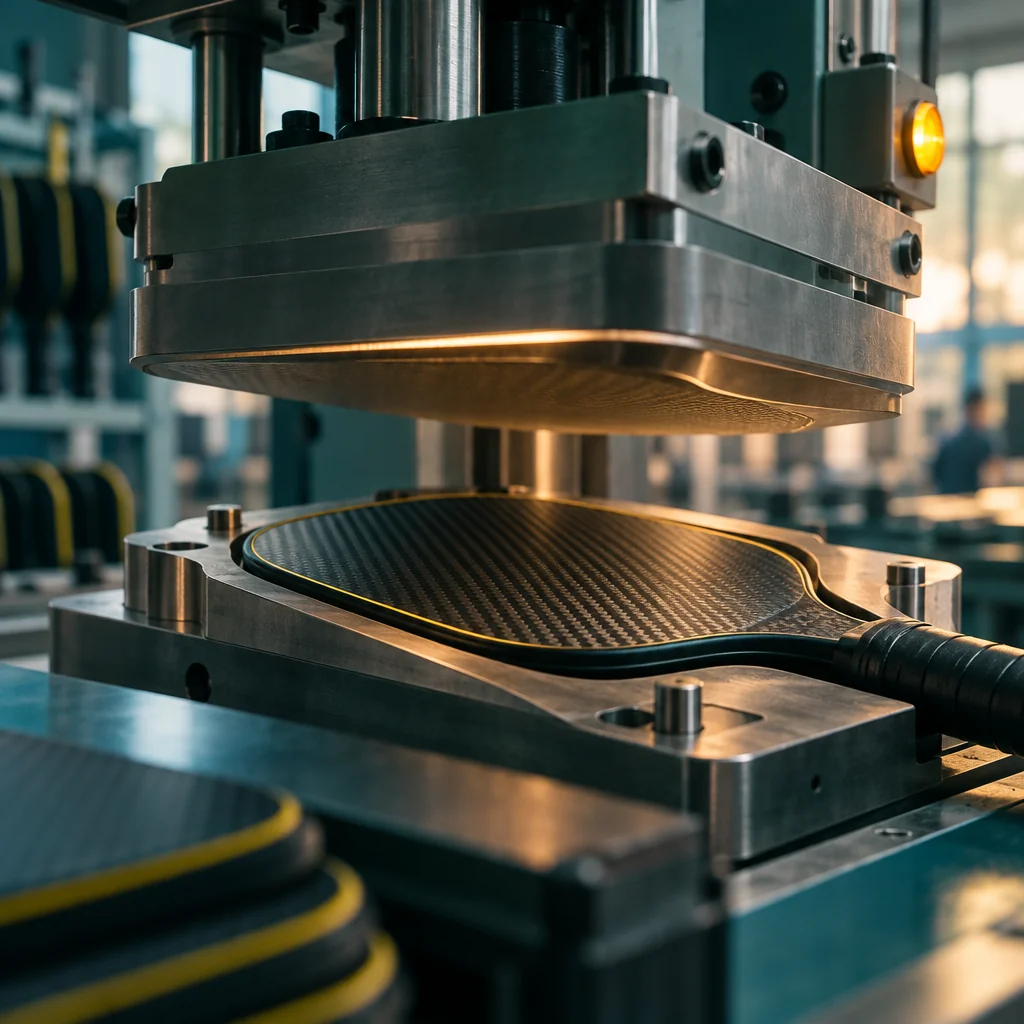
Stage 1 — Raw Materials
The face and core materials are the most visible cost driver. Face options generally range from fiberglass and composite blends to woven and raw carbon fiber, each with a different material cost. Cores are typically polypropylene honeycomb — including thicker 14.1–16mm variants associated with a softer, more control-oriented feel — or the stiffer, less common Nomex honeycomb. Higher-grade materials cost more to source and are less forgiving to work with during manufacturing, which carries through to the final price.
Stage 2 — Manufacturing Process
Turning raw material into a finished paddle involves layup, heat-press molding, edge treatment (ultrasonic welding for edgeless designs or standard edge guards), a static-dissipative coating pass, and CNC trimming to final dimensions. Precision and consistency at this stage — the difference between a factory that holds tight tolerances across a production run and one that does not — is a real cost input, even though it is invisible on a spec sheet. Our sourcing and factory capability overview goes into more detail on how this process maps to typical production lead times.
Stage 3 — Certification and Testing
Submitting a paddle for USA Pickleball or UPA-A approval means accredited lab testing for deflection, PBCoR, and surface roughness, plus dimension verification. Standard testing generally runs 4–6 weeks, or 3–8 business days on an expedited basis — both the fee and the time commitment are real costs that a non-certified paddle simply does not carry. That cost is one reason certified paddles tend to sit at a different price point than uncertified recreational models, independent of face material.
Stage 4 — Packaging and Fulfillment
Packaging ranges from a blank paddle with minimal packaging to full private-label branding with retail-ready kitting — edge guard covers, spare grip tape, and a carry bag. Each additional element adds a small, specific cost, and the choice between them is usually a brand positioning decision as much as a cost one.
Stage 5 — Distribution and Retail Markup
Everything above this point is roughly the factory-side cost. What happens next — how many intermediaries (importer, distributor, retailer) the paddle passes through before reaching a buyer — has a bigger effect on the final retail price than most of the manufacturing stages combined. This is the layer that varies most between an identical-construction paddle sold direct-to-brand versus one sold through several distribution steps.
| Cost Stage | What Drives It |
|---|---|
| Raw material | Face type (fiberglass/composite/carbon), core type and thickness |
| Manufacturing | Molding precision, edge process, CNC trimming, batch consistency |
| Certification | Accredited lab testing fees and 4–6 week standard turnaround |
| Packaging | Blank vs. private-label vs. retail-ready kitting |
| Distribution | Number of markup layers between factory and end buyer |
Comparing Cost Across Construction Tiers
Laying the five cost stages side by side against construction tier makes the price gap between entry-level and premium paddles easier to reason about. An entry-level paddle generally keeps cost low at every stage: a fiberglass or basic composite face, a standard core without the thicker premium honeycomb variants, minimal or no certification testing, and blank or simple packaging. A premium construction generally adds cost at nearly every stage simultaneously — a carbon fiber face, a tuned thicker core, full certification testing and documentation, and retail-ready packaging — which is why the price difference between tiers is rarely explained by any single factor. Understanding this stack also explains why two paddles can look similar in photos but carry very different price tags: the differences are often in stages that are not visible from the outside, like core consistency or whether certification testing was actually completed rather than just claimed.
Why This Matters Even If You Are Buying One Paddle
Understanding these stages does not require sourcing a paddle yourself — it simply makes it easier to judge whether a given retail price reflects genuine construction differences or mostly reflects distribution and brand positioning. For buyers who are sourcing at scale — private label brands, retailers, or club buyers — this cost breakdown is the actual basis for pricing decisions, not a rough guess.
The short version: paddle cost is not one number but a stack of five explainable stages, and knowing which stage you are paying for at a given price point is more useful than comparing sticker prices alone.
Where Cost and Quality Actually Diverge
The five-stage breakdown above explains a fact that surprises many buyers: retail price and manufacturing cost do not move in lockstep. A paddle can carry premium materials yet still be inexpensive to produce if it skips certification, uses simple packaging and ships directly from the factory. Conversely, a mid-tier construction can carry a high price once distribution layers and brand marketing take their share.
This divergence matters most for anyone sourcing paddles rather than buying one. Knowing roughly what each stage contributes means you can read a quote and ask sharper questions: is this price premium paying for a thicker carbon layup and tested cores, or for packaging I do not need? Buyers who understand the cost ladder negotiate differently, and they are far harder to oversell on cosmetic upgrades that add little to what actually happens when ball meets face.